Writing in the knowledge that you will be read.
No. 003 · 27 August 2026 · 3 min read
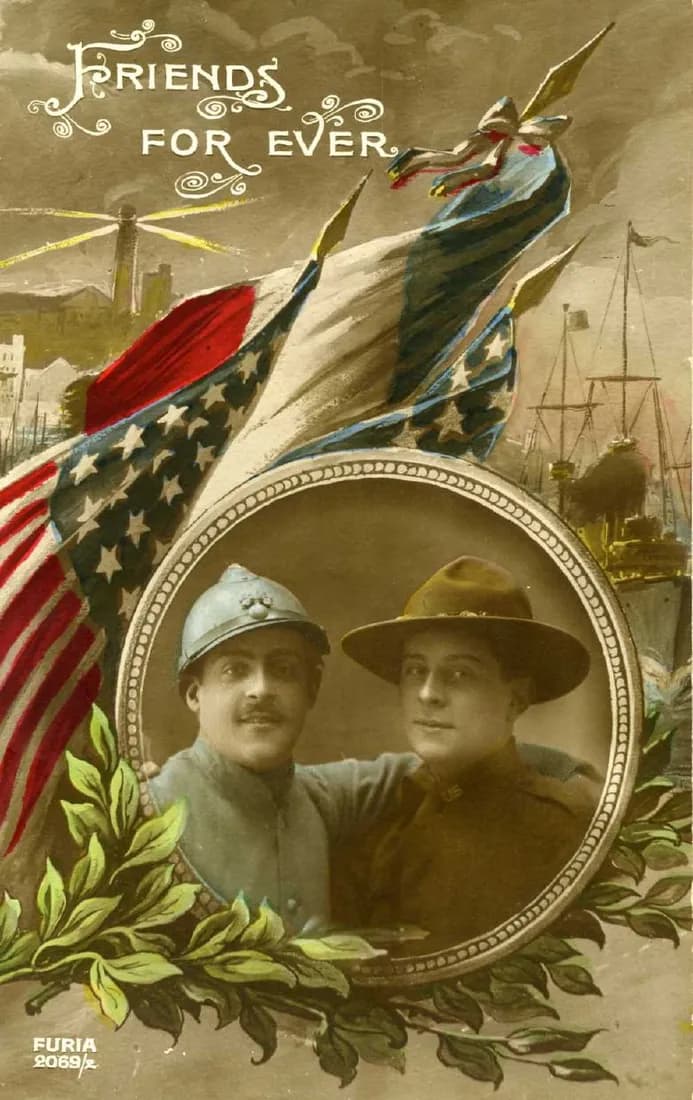
On 3 August 1914 France introduced franchise militaire, free postage for the forces: mail between soldiers and their families travelled at no charge. It was enough to write or print the words “Franchise militaire” on the envelope.
It was a decision of morale as much as of logistics. It had one immediate and unplanned consequence: the sorting offices were swamped.
First free, then read
Free postage did not come alone. Army mail was subject to postal control: it was opened, it was read, and it was delayed accordingly. The cards that have come down to us carry the trace of it, as postmarks or annotations — Vu par l'autorité militaire, seen by the military authority, recurs on hundreds of thousands of them.
It is worth stopping for a second on what that does to a sentence.
Writing to your wife knowing an officer will read the card before she does is not writing a letter under surveillance: it is writing to two recipients at once. One you reassure, the other you do not want to alarm. The constraint of 1869 — a postcard is read without being opened — stops being a theoretical nuisance and becomes the writing condition of millions of people.
The tick-box card
The military administration drew the logical conclusion and produced pre-printed cards: ready-made sentences, with the ones that do not apply struck out. I am in good health. I have been wounded. I have received your letter. All that is left is to sign and date it.
The object is efficient. It moves the essential fact — alive, not alive — without giving up anything usable, and without costing the censor a minute of reading.
It is also the point at which the constraint reaches its own limit. When all that is left is to strike out, there is nothing left to write. What gets through is the fact; what does not get through is everything else.
What the sorting produced alongside
Meanwhile, civilian postcard publishing did not stop: it converted. Views from the front, photographed ruins, allegories, patriotic cards, embroidered cards, propaganda cards like the one above — two flags, two soldiers, a laurel wreath, and three words in English to salute the entry of the United States into the war.
Those images said what had to be said. They were printed, distributed, sometimes given away. And they travelled in the same sack as the struck-out cards.
In the same week, a man could send home a hand-coloured view celebrating the alliance of peoples, with a pre-printed sentence on the back that was not his own.
What is left
Public archives now hold whole collections of this correspondence. You read it and you are struck by how ordinary it is: the weather, health, the parcel that arrived, socks.
That ordinariness is not a poverty of the period. It is what was left once you had removed what you could not say, what you did not want an officer to read, and above all what you did not want your mother to read.
Writing under constraint teaches you to say little. The postcard was waiting for exactly that.