Why we keep postcards.
No. 005 · 27 August 2026 · 3 min read
Take stock. In a drawer, somewhere in your home or your parents', there are probably a dozen postcards between twenty and fifty years old. Nobody has sorted them. Nobody rereads them. Nobody throws them out either.
Over the same period, the same family has lost, deleted or made unreadable thousands of photographs: films never developed, dead hard drives, phones replaced, accounts closed, folders in a format nothing can open any more.
The imbalance is spectacular, and it deserves better than a nostalgic explanation.
It is not scarcity
People say readily that we keep cards because they are rare, and throw away photographs because they are countless. The explanation is short and wrong.
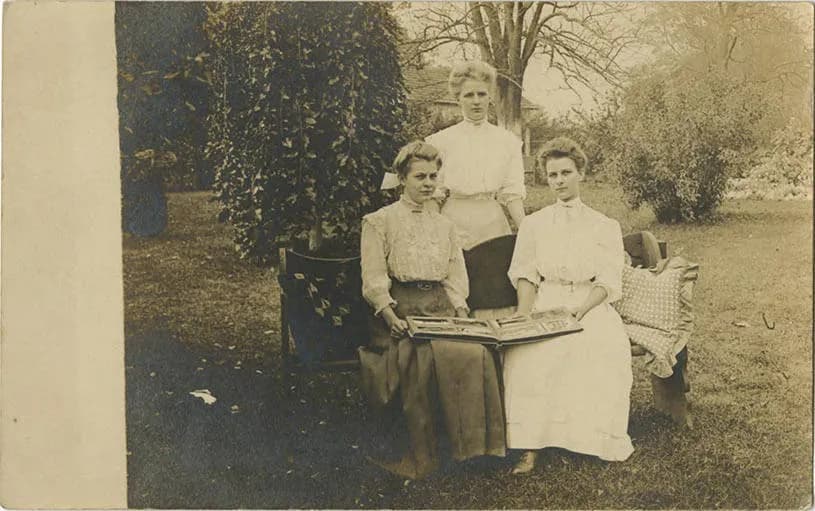
In the golden age there was nothing rare about a postcard: it cost a few centimes, was bought in series, and was sent to say you would be on the evening train. Stationers sold albums designed to hold hundreds of them. The photograph at the top of this article shows exactly that — three women, an album, an afternoon.
So they were not rare. They became rare. That is not the same thing, and it is precisely the subject.
Three material reasons, in order
A postcard is an object, and that object has properties no file has.
It takes up space. It is in a drawer, between two other things. Throwing it out takes a gesture and a decision; keeping it takes nothing. A file is the opposite: keeping it requires a repeated action — back it up, migrate it, remember the password — and losing it requires nothing at all.
There is only one of it. A digital photograph exists everywhere and therefore nowhere; you can delete it without losing anything, because you believe it is somewhere else. A card is nowhere else. Destroying it destroys it.
It carries handwriting. This is probably the decisive point. What is kept is not the image of the bay — it is somebody's hand. The wobble, the ink, the spelling mistake, the first name in the bottom right. You do not keep a postcard, you keep the trace of a gesture, and it happens to be stuck to an image.
What was lost along the way
There is a reversal that is rarely mentioned.
A hundred years ago the image was the luxury and the text was ordinary: you kept the card for the view, and the message came with it, by accident. It is to that accident that we owe being able to read today what unimportant people wrote to each other in 1905.
Today the image is free, unlimited and instant — and it is the image that disappears. What gets kept is what was written by hand.
The two periods keep the same thing, in fact: whatever cost something to produce. Only the price has changed sides.
A postcard is dated twice
Look at an old card: it carries an image of a place at a time, and a postmark saying the day someone took it to the post office. Two moments, on one piece of card, held together by the fact that they did not quite coincide — the card is always written a little after seeing the thing.
That gap is why it gets kept. A photograph says what you saw. A postcard says that you thought about it, and who you thought about.
It is not the fidelity of the image that makes a memory hold. It is that it was addressed to someone.