The scandal of writing without an envelope.
No. 001 · 27 August 2026 · 3 min read
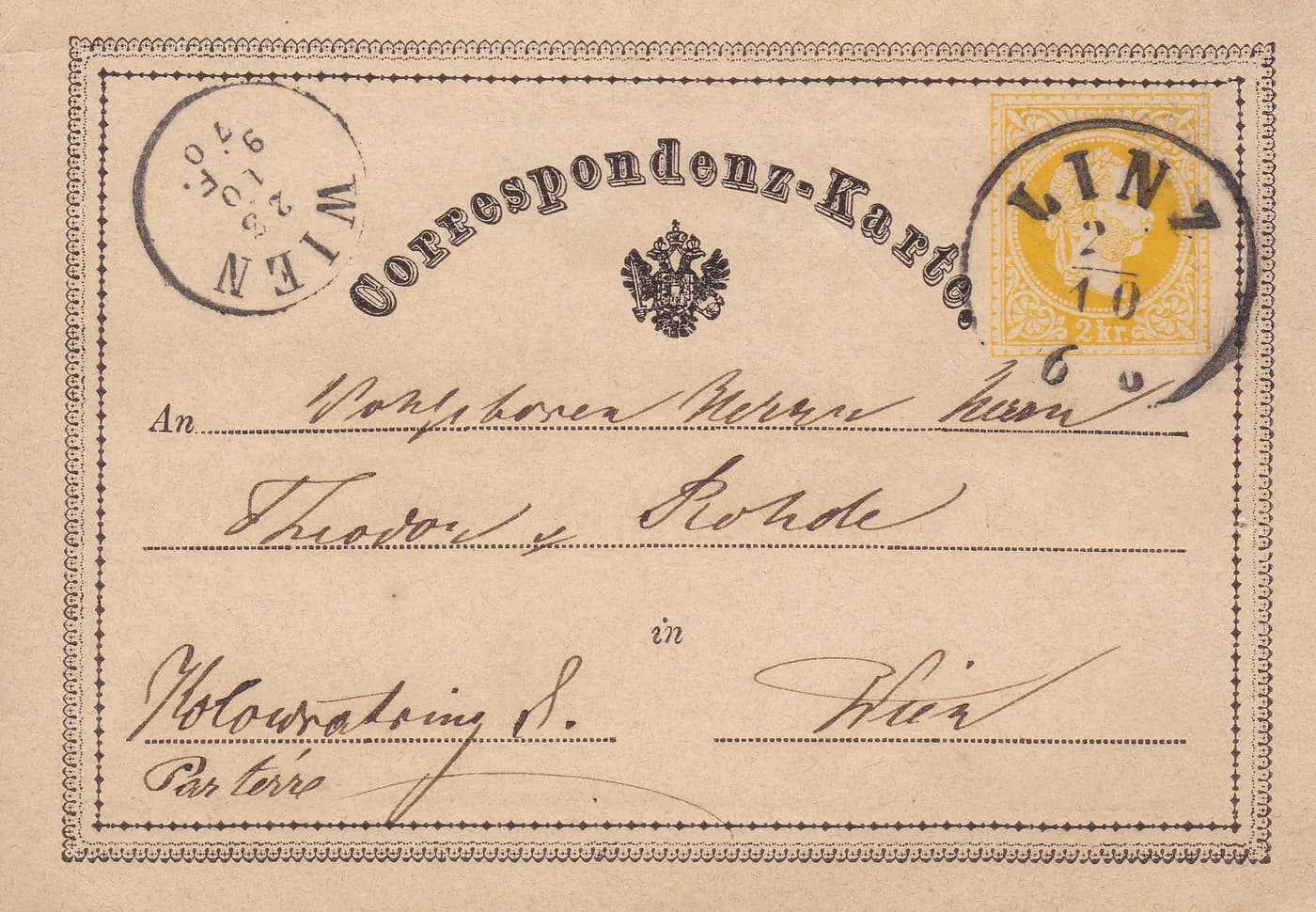
The first objection raised against the postcard was neither commercial nor technical. It was this: nobody will agree to write in the open.
An idea turned down for a good reason
In 1865, at the Karlsruhe postal conference, Heinrich von Stephan — who would later run the German post — argued for an object he called an offenes Postblatt, the open postal sheet: a stiff card the size of an envelope, written on and posted as it is, the postage already printed on it. The case for it was economy. Less paper, less handling, less epistolary ceremony to say three sentences.
The idea was set aside. His colleagues could not imagine the public entrusting its business to a card that any clerk could read along the way. The administration, for its part, feared the complexity: every German state had its own stamps and its own rates.
It is worth weighing what that refusal was worth. It was not the objection of conservatives. It was an exact reading of the object: a postcard really is legible to everyone who carries it. The objection was right. It has never been resolved.
Vienna remembers
The 1865 conference was Austro-German, and the Austrian postal officials were in the room. The idea went home with them.
On 26 January 1869 a Viennese economist, Emanuel Herrmann, published an article in the Neue Freie Presse that took up the proposal and gave it a precise shape: a card the size of an envelope, twenty words at most, at a reduced rate. This time the administration followed. On 1 October 1869 the Austro-Hungarian post put the Correspondenz-Karte on sale, printed in German and in Hungarian.
The success was immediate, and it held. What the card at the top of this article shows is not the first in the world — it is an ordinary example, posted from Linz to Vienna on 22 October 1870, a year later. It carries an address, a two-kreuzer stamp, two postmarks. Nothing else. It is exactly the object von Stephan had described.
France waits three years
It took the law of 20 December 1872, on correspondence “in the open”, for France to take it up. The first state cards were issued in January 1873.
They are not illustrated, and nobody has thought of that yet. They are bare cards: one face for the address, one face for the text. The image comes later, and it changes everything — but that is another story.
What the objection produced
The 1865 objection was never refuted. It was accepted.
A postcard is read without being opened, and everyone knows it, starting with the person writing it. That is not a flaw in the format: it is its rule. It produced a way of writing that did not exist before, and exists nowhere else — short, outward-facing, made to be read sideways by a postman, a concierge, a brother who fetches the mail.
You do not write on a postcard what you would write in a letter. You write what you could say out loud in a corridor. It is thinner, and it is also why a postcard gets kept: there is nothing in it that has to be hidden.
The refusal of 1865 was right about the facts and wrong about the consequences. People agreed to be read. They simply changed what they wrote.