When the postcard was the instant message.
No. 002 · 27 August 2026 · 3 min read
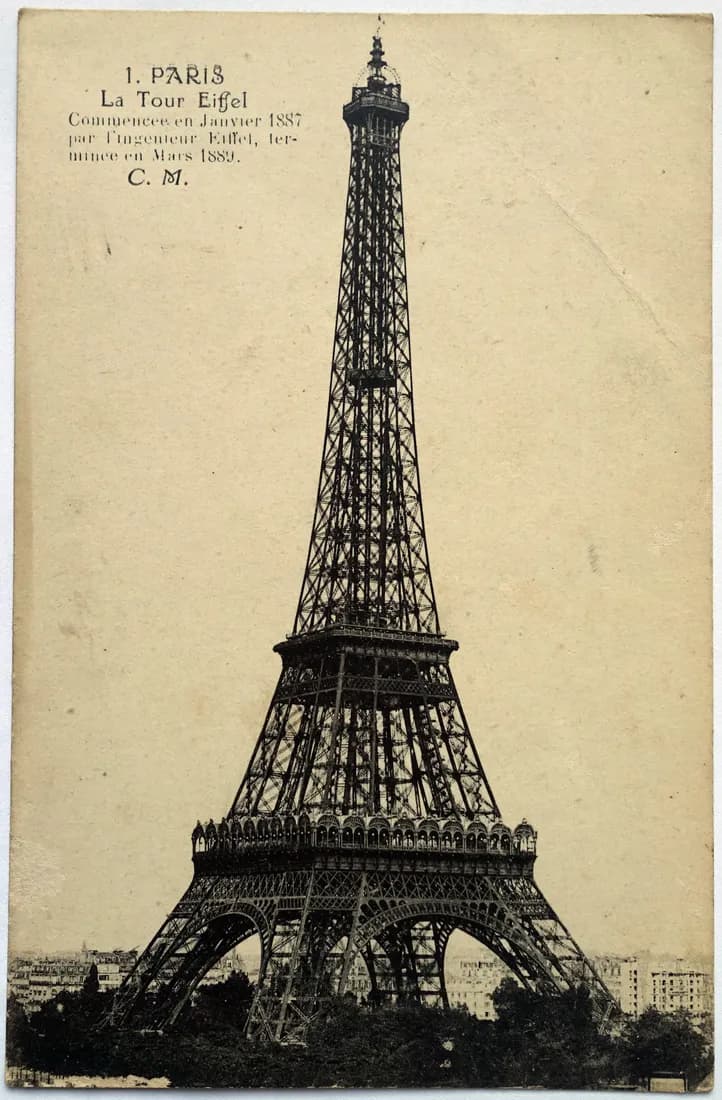
The 1873 card is a bare piece of board. What turns it into the object we know is the image — and the image arrives sixteen years later.
1889: one tower, one third of a card
The 1889 Exposition Universelle gives France its first official illustrated postcard. It is known as the “Libonis”, after its draughtsman, Léon-Charles Libonis. The drawing of the Eiffel Tower takes up only the left third of the face; the rest is left for writing.
Two years later, in 1891, a Marseille merchant named Dominique Piazza solves a purely technical problem: shrinking a photograph enough to fit three of them onto a card. He sends the result to a friend who has left for America. The photographic postcard exists.
From there the machinery runs away with itself, for a simple reason: the image gives you a reason to send. A bare card is written when you have something to say. A view is sent because you have seen it.
The rhythm we have forgotten
What makes the golden age hard to picture today is not the volume. It is the speed.
In cities, the post did not come once a day. It came several times. You wrote a card in the morning that arrived in the afternoon, you fixed a meeting for that same evening, you warned that you would be on the six o'clock train. The postcard of 1905 does not do the job of the postcard of 2026 — it does the job of the message we now send from a phone.
That explains the texts found on them, the ones that so disappoint collectors hoping for confidences. “Arrived safely.” “See you Sunday.” “Nothing from you.” These are not failed letters. They are short messages, in the only short medium that existed.
The back that changes everything
Until early 1904, in France, writing on the back of a postcard was forbidden. The reverse was reserved for the address and nothing else: three or four lines across the card. So the message had to be squeezed onto the illustrated face — in the sky, in the margin, around the bell tower.
An order of 18 November 1903, applied from the following month, finally allowed the reverse to be shared: correspondence on the left, address on the right. This is what is called the divided back, and it is the layout still in use today.
The reform did not happen everywhere at once — the United Kingdom had adopted it as early as 1902, Germany followed in 1905, the United States in 1907. Some cards from that period carry a printed warning: correspondence on the reverse is not accepted by every foreign country, ask at the post office.
It is an administrative detail. It is also the moment when the image stops sharing its space with the text, and becomes a full image.
Then we filed them away
The other trait of the period is that nothing was thrown out. It was collected.
Stationers sold albums made for the purpose, with the number of pockets announced on the cover. People swapped, completed series, sorted by town. A whole domestic practice organised itself around a ten-centime object.
That is why we can still read today what people wrote to each other in 1905: not because those messages were worth anything, but because the image was worth enough for the message to be kept with it.
The war interrupts all of this — and gives the postcard a use it had not planned for.