What people write on the back.
No. 004 · 27 August 2026 · 3 min read
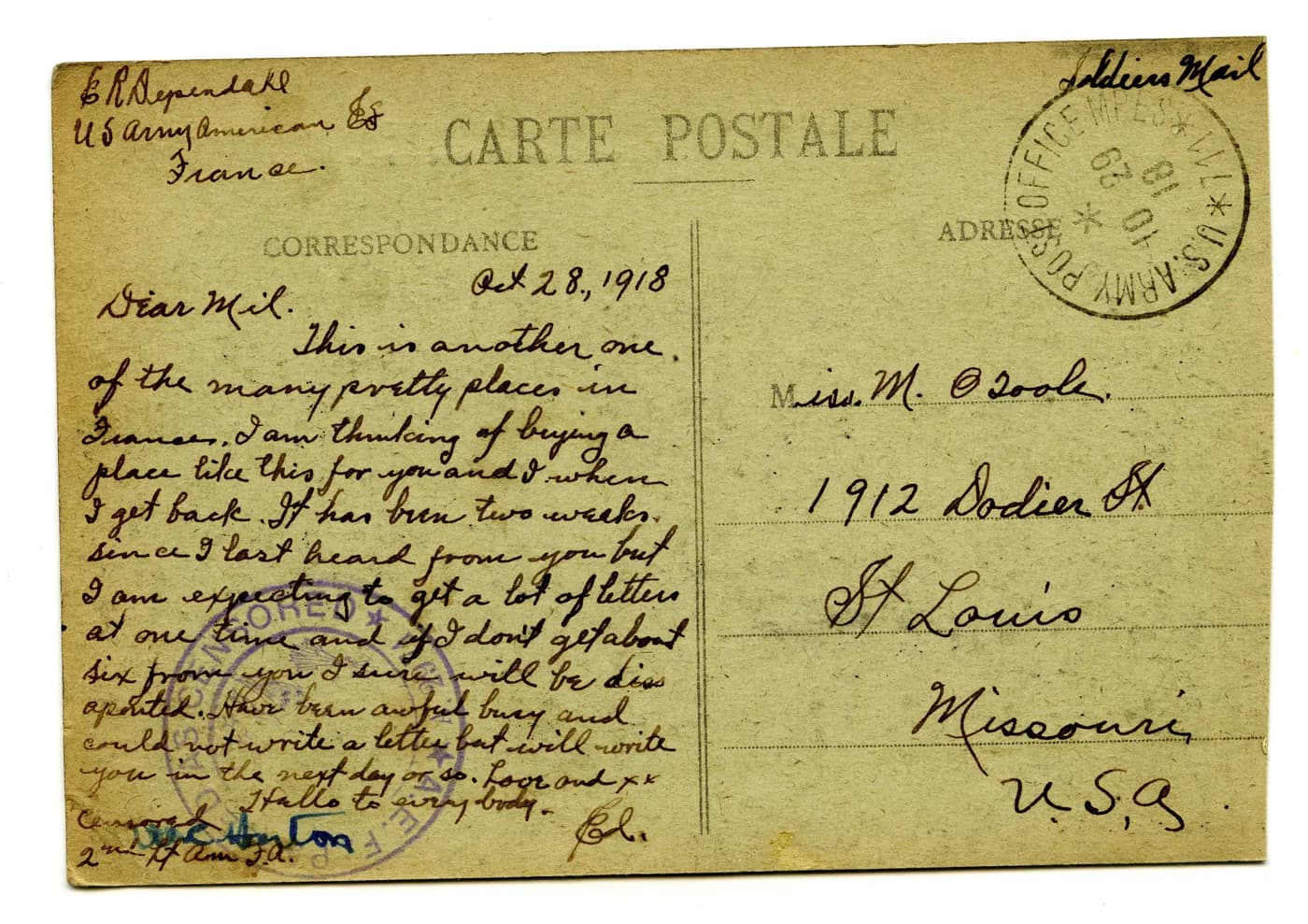
Take any postcard you have received in your life. There is a good chance it contains three of these six sentences:
- the weather is fine, or it is raining;
- the food was good;
- we are thinking of you;
- it is very pretty here;
- we are back on Sunday;
- love.
We laugh about it readily. We read it as laziness, or as proof that nobody has anything left to say. That is a misreading: these six sentences are exactly what the object was designed to carry, and they have a history.
The format began by forbidding writing
Until early 1904, in France, writing on the back of a postcard was forbidden. The reverse belonged to the address, and to nothing else. The message had to be squeezed onto the illustrated face: in the sky, in the white margin, across a roof.
So there was no room. Not figuratively — literally, in centimetres. An order of 18 November 1903, applied the following month, finally allowed the reverse to be shared: correspondence on the left, address on the right. That is the layout in the image above, and the one still in use.
Twenty years earlier, this text could not have been written there.
Half a back is not little — it is framed
The left half of a card is room for thirty to sixty words. Far less than a letter. Far more than a telegram.
That format calls for neither narrative nor developed feeling. It calls for a news item on three points: where we are, whether all is well, when we are back. Add that the card will be read by the postman, the concierge and whoever picks it up off the hall table — and you get our six sentences, mechanically.
They are not the least bad thing anyone could come up with. They are the right answer to a precise constraint.
What the counted cards say
This can be checked, and researchers have checked it. The Edwardian Postcard project run by Julia Gillen and Nigel Hall transcribed and categorised three thousand British postcards actually posted in the early twentieth century. The corpus is now openly available through Lancaster University's digital collections.
What that work describes is not a miniature epistolary art, but fast multimodal communication in ordinary, familiar language: an image and a few words, combined, to get an almost instant message across.
In other words: our six sentences, a century earlier, in more careful spelling.
The part we forget to count
There is one thing this reasoning leaves out, though, and it may be the most important.
A postcard is not made of its text alone. It is made of an image and a text, and the image carries half the message. “It is very pretty here” is not an empty sentence when it is written on the back of a photograph of the place in question: it is a caption. It does not describe the place — the image does that. It says who is looking, and who they are thinking of.
The six sentences are hollow only if you read the back without looking at the front. Nobody receiving a card makes that mistake.
Why none of it has moved
The telephone changed nothing, email neither, instant messaging no more. Not because the postcard resists, but because it does not do the same job.
What it carries is not information — that has been travelling elsewhere, faster, for a long time. What it carries is the proof that someone took the time: buying the card, finding a stamp, writing standing up at a counter, looking for the postbox. The content of the message was never the message.
Hence the six sentences. They leave room for the thing that counts, which is the gesture.